The main open-source alternatives to Langfuse are Arize Phoenix, Helicone, Opik, OpenLIT and Tracium. They differ in how data gets in (OpenTelemetry export or a proxy), what they are strongest at (evals, routing, GPU monitoring or cost), and how they tell you something has gone wrong. Langfuse, Helicone, Opik and OpenLIT alert on thresholds you set; Tracium learns each workflow’s normal daily cost, error rate and run volume and flags outliers on its own.
- Phoenix and Opik are the closest match if evaluations are your main need; Helicone if you want a gateway.
- Most tools here can alert, but on static thresholds: you pick the number, and you have to guess it before the incident.
- Tracium scores every busy workflow against its own trailing baseline, catches drops as well as spikes, and names the release that likely caused them.
- Attribute names still matter: Tracium reads GenAI-semconv and OpenLLMetry token names, not OpenInference’s.
When does it make sense to look beyond Langfuse?
Langfuse is a solid default: tracing, evals, datasets and prompt management in one self-hostable product. Teams look elsewhere for a different licence, a gateway, or because they learned about a cost spike from the invoice rather than their tooling.
How would each tool tell you something broke?
If an agent starts looping tonight, who notices, and when? As of October 2026, from each project’s own docs:
| Tool | Licence | How data gets in | How it alerts |
|---|---|---|---|
| Langfuse | MIT core, separate ee/ licence | SDKs, or OTLP over HTTP | Monitors: fixed ranges on cost, scores or latency, sent to Slack, webhooks or GitHub Actions |
| Arize Phoenix | Elastic License 2.0 | OpenTelemetry with OpenInference | No built-in alerts in Phoenix’s docs; monitors are in Arize’s commercial AX |
| Helicone | Apache 2.0 | AI gateway, or async logging | Fixed thresholds on cost, errors, latency or tokens over a time frame, to email or Slack |
| Opik | Apache 2.0 | SDKs, or OTLP over HTTP | Fixed thresholds on errors, cost, latency or scores, to Slack, PagerDuty or webhooks |
| OpenLIT | Apache 2.0 | Its own OpenTelemetry SDK | Fixed thresholds shown in the app; Slack, email and other destinations need Enterprise |
| Tracium | Apache 2.0 | Any OTLP over gRPC or HTTP | Learned per-workflow baselines for cost, error rate and runs; Slack and email alerts on Tracium Cloud |
What is the difference between a threshold and a learned baseline?
A threshold fires when a number crosses a line you chose; a baseline fires when a number is unusual for that workflow. Thresholds work when you know the line, baselines when you have forty workflows and no idea what normal is for each.
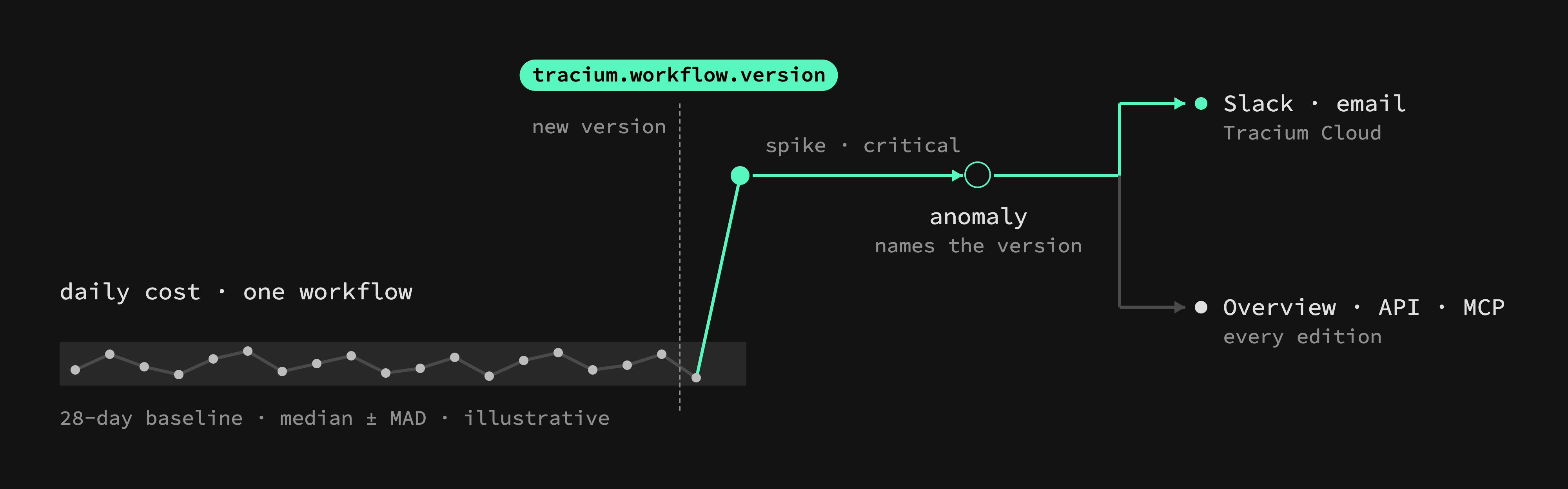
Tracium scores each day against the previous 28 days using the median and median absolute deviation, so earlier spikes don’t inflate the baseline and hide the next one. It needs 10 active days before it judges a series, ignores cost moves under $1 a day, and grades results info, warning or critical. Run volume is checked for drops too, because a workflow that quietly stops running never crosses a ceiling.
If you set tracium.workflow.version as a resource attribute, an anomaly that follows a new version names it:
export OTEL_RESOURCE_ATTRIBUTES="service.name=support-agent,tracium.workflow.version=2026-10-28"Arize Phoenix: strongest for evals on OpenTelemetry
Phoenix is the pick if evaluations matter as much as tracing, with built-in cost tracking. Its licence only matters if you plan to host it for others.
Helicone, Opik and OpenLIT: broad platforms with threshold alerts
Helicone sits between your app and the provider, giving you logging, routing and fallbacks; its alerts can group by user or model. Opik covers tracing, evals and prompt management, with alerts that reach PagerDuty. OpenLIT adds guardrails and GPU monitoring.
Tracium: outlier alerts on plain OpenTelemetry
Tracium is an OpenTelemetry Collector distribution with a dashboard on top, not an SDK. The collector prices every model call from its model name and token counts, and the API scores the workspace and its 50 busiest workflows for anomalies. Every edition shows them on the Overview and through the API and MCP server; Tracium Cloud’s paid plans also send them to Slack or email.
I built it because I needed it: one Aqtos feature had context growing call after call, and fixing it took it from $0.1583 to $0.000099 per agent call. I want that kind of outlier flagged the day it starts.
When Tracium is a good fit: you run many agents or workflows on OpenTelemetry or OpenLLMetry, you don’t want to hand-tune a threshold for each, and you want to self-host. When another tool is better: you need evals, datasets or prompt management (Tracium has none), a gateway (Helicone), alerts within minutes rather than daily, or you instrument with OpenInference.
Which alternative fits which team?
- Evals and experiments first: Phoenix or Opik.
- One endpoint for many providers, with fallbacks: Helicone.
- Self-hosted models and GPUs to watch: OpenLIT.
- Many workflows and no time to set thresholds for each: Tracium. Docs: setup, anomalies.
FAQ
Does Langfuse have alerts?
Yes. Langfuse Monitors notify Slack, webhooks or GitHub Actions when a metric such as cost per trace leaves a range you define. The range is fixed, so you choose it per metric in advance.
Which Langfuse alternative detects anomalies without thresholds?
Tracium compares each workflow’s daily cost, error rate and run volume with its own previous 28 days and flags outliers automatically. The other tools here that alert use fixed values you configure.
Is Arize Phoenix open source?
Phoenix’s code is public under the Elastic License 2.0, a source-available licence. You can self-host and modify it, but you can’t provide it to others as a hosted service.
Can I move from Langfuse without changing my instrumentation?
If you already send OpenTelemetry, usually yes: point the exporter at the new backend. Check that it reads your library’s token attribute names first.
If you would rather hear about a runaway agent from your tooling than from your invoice, try the open-source repo at github.com/antonij-tracium/tracium with one docker compose up, or sign up free at app.tracium.ai.